

Situational Leadership in Singapore:
A Practical Guide to SLII® for Managers
Managing people effectively is rarely as simple as choosing one leadership style and using it with everyone.
A new team member learning an unfamiliar task may need clear direction and frequent guidance. An experienced employee handling work they have successfully completed many times may need something very different: autonomy, trust and the space to make decisions.
This is the thinking behind situational leadership — adapting how you lead according to what a person needs for a particular goal or task.
For managers in Singapore navigating increasingly diverse teams, changing expectations and fast-moving workplaces, the ability to adjust between direction and support can be an important leadership skill.
Blanchard’s SLII® model provides leaders with a practical framework for doing exactly that.
What Is Situational Leadership?
Situational leadership is an approach based on a simple principle:
Effective leadership depends on the person, the task and the situation.
Instead of assuming there is one universally effective leadership style, leaders adjust the amount of direction and support they provide according to what an individual needs to succeed.
This means effective leadership is flexible.
A manager may need to be highly directive when an employee is completing a task for the first time, more coaching-oriented as that employee develops, supportive when confidence becomes the main barrier, and eventually comfortable delegating when the employee can perform independently.
Blanchard’s SLII® leadership model turns this principle into a practical framework managers can apply to everyday conversations and performance situations.
According to Blanchard, the model combines four development levels with four corresponding leadership styles and is designed to help leaders adapt their approach to individual needs.
How Does the SLII® Model Work?
At the heart of SLII® is the idea that leadership should be matched to a person’s needs for a specific goal or task.
That distinction matters.
An employee should not simply be labelled as a particular “type” of person.
Someone may be highly capable and independent when preparing a monthly financial report but require considerably more direction when asked to lead a client presentation for the first time.
Their development level can therefore vary depending on what they are trying to accomplish.
Blanchard identifies three practical skills leaders use when applying SLII®:
Goal Setting
The leader and team member first establish a clear understanding of what needs to be accomplished.
Without clarity around the goal, it becomes difficult to determine what support or direction is actually needed.
Matching
The leader considers the team member’s current competence and commitment in relation to the specific goal or task.
This helps the leader understand what the person needs at that moment rather than relying on assumptions.
Diagnosing
The leader then provides an appropriate combination of direction and support.
The aim is not to stay in one leadership style permanently. It is to adjust as the person’s needs and capability develop.
Blanchard describes goal setting, diagnosing and matching as core skills for applying SLII®.
The Four Development Levels in SLII®
SLII® describes four development levels.
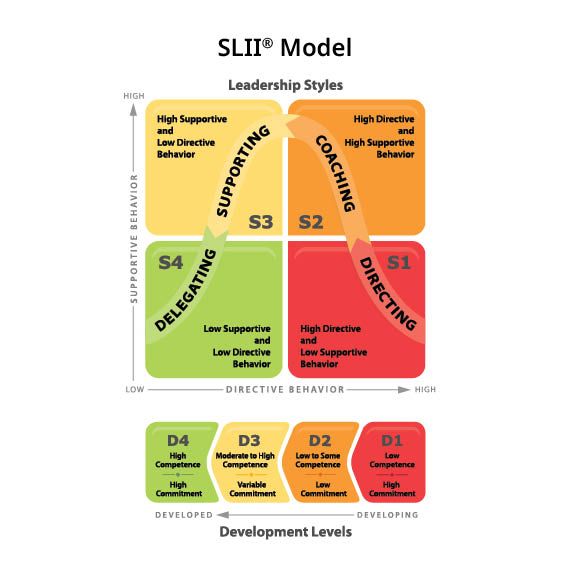
D1 — Enthusiastic Beginner
Someone at D1 is often excited and willing to take on a goal or task but has not yet developed the competence required to complete it independently.
Think of a newly promoted manager conducting performance reviews for the first time.
They may be motivated, but they still need clarity around the process, expectations and steps involved.
What they generally need:
Clear direction, structure and guidance.
D2 — Disillusioned Learner
At D2, some competence has developed, but the task may be more difficult than the person originally expected.
Early enthusiasm can fall as challenges become clearer.
For example, a manager may understand how performance conversations are supposed to work but struggle when an employee becomes defensive during the discussion.
What they generally need:
Continued direction together with encouragement, explanation and support.
D3 — Capable but Cautious Contributor
At this level, competence is stronger, but confidence or commitment may fluctuate.
The employee may know what to do yet hesitate when faced with a particularly challenging situation.
For example, an experienced manager may know how to give feedback but feel uncertain about addressing a sensitive performance issue with a long-serving team member.
What they generally need:
Less instruction and more listening, encouragement and involvement.
D4 — Self-Reliant Achiever
A person at D4 has both the competence and commitment needed to perform a particular task independently.
They understand what success looks like, can make appropriate decisions and require relatively little supervision.
What they generally need:
Autonomy, trust and appropriate delegation.
The important point is that these levels describe someone’s development for a particular goal or task, rather than defining their overall ability or personality.
The Four SLII® Leadership Styles
Once a leader understands what the individual needs, the next step is matching the appropriate leadership behaviour.
SLII® uses four leadership styles.
S1 — Directing
High direction, lower support
The leader provides specific guidance around what needs to happen, how it should be done and what success looks like.
This is useful when someone is enthusiastic about a task but does not yet have sufficient experience to complete it independently.
Directing should not be confused with controlling every detail indefinitely.
The objective is to create the clarity someone needs to begin developing competence.
S2 — Coaching
High direction, high support
The leader continues to provide guidance but also spends more time listening, explaining decisions, asking questions and encouraging progress.
This is particularly useful when a team member has started developing competence but is encountering difficulties or losing confidence.
S3 — Supporting
Lower direction, high support
At this stage, the leader steps back from telling the person exactly how to perform the task.
Instead, the focus shifts towards listening, facilitating problem-solving and building confidence.
The employee increasingly contributes to decisions and takes ownership.
S4 — Delegating
Lower direction, lower support
The employee has demonstrated the competence and commitment required to handle the task with greater independence.
The leader establishes appropriate accountability but avoids unnecessary involvement.
Blanchard describes Directing, Coaching, Supporting and Delegating as the four leadership styles within the SLII® framework.
Why One Leadership Style Does Not Work for Every Employee
Imagine two people in the same Singapore-based organisation.
Aisha has spent five years managing existing corporate accounts but has just been asked to lead a complex regional pitch for the first time.
Daniel has successfully led similar pitches across multiple markets.
Giving both employees exactly the same level of guidance would make little sense.
If their manager simply says:
“You’re both capable. I trust you. Handle it.”
Daniel may perform very well.
Aisha, however, might struggle — not because she lacks potential, but because this particular responsibility is new.
The opposite can also happen.
If the manager gives Daniel detailed instructions for every slide, meeting and email, Daniel may feel unnecessarily controlled.
This is one reason leadership flexibility matters.
The better question is not:
“What is my leadership style?”
It is:
“What does this person need from me to succeed at this particular goal?”
That shift changes leadership from a fixed personal preference into a deliberate response to another person’s needs.
For managers interested in exploring other leadership approaches, Blanchard Singapore also provides an overview of leadership development programs for different organisational needs.
A Practical Situational Leadership Example in the Singapore Workplace
Consider a manager leading a team implementing a new customer relationship management system.
Stage 1: The Employee Is New to the System
The employee is enthusiastic but has never used the platform.
Rather than saying, “Explore it and let me know if you have questions,” the manager provides:
- clear expectations;
- step-by-step guidance;
- examples of correctly completed work;
- milestones; and
- regular check-ins.
This is closer to a Directing approach.
Stage 2: The Employee Encounters Problems
After several weeks, the employee understands the basic system but becomes frustrated with more complex functions.
The manager continues providing direction while asking questions, explaining why certain processes matter and encouraging the employee to keep developing.
The approach moves towards Coaching.
Stage 3: Competence Improves, but Confidence Varies
The employee now understands the system well but hesitates to make decisions without checking with the manager.
Instead of continuing to provide instructions, the manager asks:
“What do you think the best approach would be?”
The employee begins solving problems independently while the manager provides reassurance and discussion when necessary.
The manager has moved towards Supporting.
Stage 4: Independent Performance
Eventually, the employee uses the system confidently, handles exceptions effectively and can even help colleagues.
The manager no longer needs to be involved in routine decisions.
Responsibility can increasingly be Delegated.
The employee did not suddenly become a different person at every stage.
What changed was their development in relation to that particular responsibility — and therefore what they needed from their manager.
Common Mistakes Managers Make When Using Situational Leadership
Understanding the four styles is useful, but applying them requires judgement.
Mistake 1: Labelling People Instead of Diagnosing the Task
Saying “Daniel is a D4” oversimplifies the model.
Daniel may be highly competent at one responsibility and inexperienced at another.
Always diagnose development in relation to a specific goal or task.
Mistake 2: Giving Too Much Direction to Experienced Employees
Managers sometimes continue providing detailed instructions long after employees have developed the capability to work independently.
What began as helpful guidance can eventually feel like micromanagement.
If this is a challenge for your managers, our guide on how to lead without micromanaging provides additional practical guidance.
Mistake 3: Delegating Too Quickly
The opposite problem is assuming that giving someone complete independence automatically demonstrates trust.
Delegation works best when the person has developed the competence and commitment necessary for the responsibility.
Too little direction too early can create unnecessary confusion.
Mistake 4: Assuming Confidence Equals Competence
A confident employee may still lack experience.
Likewise, a highly competent employee can temporarily lose confidence when handling an unfamiliar or high-stakes situation.
Good diagnosis considers both competence and commitment.
Mistake 5: Using Leadership Flexibility as Inconsistency
Adapting your leadership style does not mean changing expectations arbitrarily.
Goals, standards and accountability should remain clear.
What changes is the amount and type of support the leader provides to help the person achieve those expectations.
Who Can Benefit from SLII®?
SLII® can be particularly relevant for:
- first-time managers learning how to lead different personalities and experience levels;
- experienced managers who want to become more flexible in how they develop people;
- team leaders managing employees with different levels of capability;
- project leaders working across functions;
- HR and L&D teams building a common leadership language across an organisation; and
- organisations preparing future leaders for larger responsibilities.
It can also be useful when managers are navigating transitions.
For example, someone promoted internally may suddenly need to lead people who were previously colleagues. Our guide to managing former peers after a promotion explores that leadership transition in more detail.
Why Situational Leadership Matters in Today's Workplace
Modern managers rarely lead teams in which everyone has the same experience, motivation or development needs.
One team may include new graduates, experienced specialists, recently promoted managers, remote employees and colleagues working across multiple countries.
At the same time, new technology and changing business priorities regularly place experienced employees in situations where they become learners again.
A leader who can only direct may create dependency.
A leader who only delegates may leave people without the support they need.
A leader who only coaches may spend unnecessary time supporting people who are already capable of working independently.
Flexible leadership gives managers another option: diagnose first, then respond.
That people-centred flexibility is also increasingly relevant as organisations adopt AI and other technologies. Technology may change the work being performed, but managers still need to understand confidence, competence, motivation and individual needs. Read more in our article on human-centred leadership in the age of AI.
How Can Managers Learn SLII® in Singapore?
Reading about a leadership model is useful.
Applying it consistently during real conversations is where the challenge begins.
Blanchard Singapore’s SLII® leadership development program helps managers learn how to set clear goals, diagnose development needs and match their leadership behaviour to what each person requires.
The program focuses on applying the framework to practical leadership situations rather than relying on a single default management style.
Organisations can explore the SLII® leadership program in Singapore to understand the learning approach and organisational applications.
Individuals who would prefer to attend an upcoming public run can also view the SLII® Singapore workshop and registration details.
Frequently Asked Questions About Situational Leadership
What is situational leadership in simple terms?
Situational leadership means adjusting how you lead according to what a person needs for a specific goal or task.
Rather than using one fixed management style, the leader considers the individual’s competence and commitment and provides an appropriate level of direction and support.
What are the four SLII® leadership styles?
The four SLII® leadership styles are Directing, Coaching, Supporting and Delegating.
They represent different combinations of directive and supportive leadership behaviour.
What are the four SLII® development levels?
The four development levels are Enthusiastic Beginner, Disillusioned Learner, Capable but Cautious Contributor and Self-Reliant Achiever.
Development level should be considered in relation to a particular goal or task rather than used as a permanent label for an employee.
Is situational leadership only for new managers?
No.
First-time managers can benefit from having a practical framework for understanding what their employees need, but experienced managers can also use situational leadership to become more intentional and flexible in how they develop people.
Can the same employee be at different development levels?
Yes.
Someone may be highly capable at one responsibility and relatively inexperienced at another. SLII® therefore considers development level in relation to a specific goal or task.
Where can I attend SLII® training in Singapore?
Blanchard Singapore offers SLII® leadership development for managers and organisations in Singapore, including public workshop options and leadership development solutions for organisations.
You can explore SLII® training in Singapore or view the upcoming SLII® workshop.
Build Leaders Who Know When to Direct, Coach, Support and Delegate
Leadership flexibility does not mean lowering expectations.
It means understanding what people need to reach those expectations.
By learning to set clear goals, diagnose development needs and match the right combination of direction and support, managers can create greater clarity while helping people become increasingly capable and self-reliant.
If you are looking to strengthen these skills across your managers, explore the SLII® leadership training program in Singapore.
Looking to join as an individual?
View the upcoming SLII® Singapore workshop and registration details.